A study of the Greek word for Take / Receive in John 20:22
John 20:19-23
On the evening of that first day of the week, when the disciples were together, with the doors locked for fear of the Jewish leaders, Jesus came and stood among them and said, “Peace be with you!” After he said this, he showed them his hands and side. The disciples were overjoyed when they saw the Lord.
Again Jesus said, “Peace be with you! As the Father has sent me, I am sending you.” And with that he breathed out and said, “Take the Holy Spirit. If you forgive anyone’s sins, their sins are forgiven; if you do not forgive them, they are not forgiven.”
In English, we have the words "take" and "receive" but in Greek, they are the same word.
In many contexts, these words are interchangable.
In John 20:22, does Jesus command the disciples to 'take' or to 'receive' the Holy Spirit.
"As the Father has sent me, I am sending you. Take / Receive the Holy Spirit. If you forgive anyone's sins, they are forgiven; if you do not forgive them they are not forgiven."
The word for take/receive is a command and hence does not indicate when the action in the command is to take place even though it is in the aorist tense.
This word, in this tense, is only used seven times in the New Testament and on all the other occasions it is translated as 'take'.
In this context, it makes more sense to translate it as 'take' as it would not introduce an event that is not recorded in the other Gospels and it would indicate that Jesus was going to give them the Holy Spirit to empower them to do what he was commanding them to do (the Royal Commission).
There are no other accounts in the Bible to say that the disciples 'received' the Holy Spirit on resurrection Sunday when Thomas was missing from the group.
In fact the Luke account would suggest that Jesus told the disciples to stay in Jerusalem until they were given power from upon High.
The disciples were filled with the Holy Spirit at Pentecost when the Holy Spirit came upon them in power. Many others received the Holy Spirit. This was the first incidence of Baptism of the Holy Spirit.
See below
A Study of New Testament Greek
Strongs Number G2983
Goodrick Kohlenberger Number 3284

Root Word : lambano
Meanings: "take" "carry" "accept" "receive" "bring"
261 Occurences in the New Testament
These are some of the tenses it is used in the New Testament
1

26 occurrences in the New Testament
Translated as: received, took, accepted, caught
Matt:12:14 Matt 20:9 Matt 20:10 Matt 22:15 Matt 25:3 Matt 25:4 Matt 27:1 Matt 27:9 Matt 27:30 Mark 14:65 John 1:12 John 10:18 John 12:13 John 17:8 John 19:23 John 19:40 Acts 10:47 Acts 20:24 2Cor 11:24 2Cor 12:16 Phil 3:12 Heb 11:35 Heb 11:36 Rev 10:10 Rev 17:12 Rev 20:4
2

7 occurrences in the New Testament
Translated as: take, receive
Matt 26:26 Mark 14:22 Luke 22:17 John 18:31 John 19:6 John 20:22 James 5:10
3

5 Occurences in the New Testament
Translated as: receive, accept
Matt 21:22 John 5:43 John 16:24 Acts 1:8 Acts 2:38
4

3 occurrences in the New Testament
Translated as: receive, get
Acts 8:15 1Cor 9:25 Heb 9:15
5

1 occurrence in the New Testament
Translated as: received
Acts 8:17
6

11 occurrences in the New Testament
Translated as: received, gathered
Matt 10:8 Matt 16:9 Matt 16:10 Mark 11:24 Acts 7:53 Acts 19:2 Rom 8:15 2Cor 11:4 Gal 3:2 Col 4:10 1John 2:27
How are these words used in relation to the Holy Spirit?
The following Greek words are all related to the same root word 'Lambano' which means 'to take' or 'to receive'

These Greek words are derived from the same root word and have the same Strong's number G2983. (see note)
They are all used together with the words 'Holy Spirit'
But do they all have the same meaning when used in conjunction with the words 'Holy Spirit'?
Should this word be translated as 'take' in John 22:22?
See Message on Taking or Receiving
See message on John 20:22

Examples
| Verse | Greek | English (NIV) |
| John 1:12 |  |
Yet to all who received him, to those who believed in his name, he gave the right to become children of God-- |
| John 20:22
|
 |
And when he had said this, he breathed on them, and said to them, Receive the Holy Spirit. |
| Acts 2:38 |  |
Peter replied, "Repent and be baptized, every one of you, in the name of Jesus Christ for the forgiveness of your sins. And you will receive the gift of the Holy Spirit. |
| Acts 8:15 |  |
When they arrived, they prayed for them that they might receive the Holy Spirit, |
| Acts 8:17 |  |
Then Peter and John placed their hands on them, and they received the Holy Spirit. |
| Acts 10:47 |  |
"Can anyone keep these people from being baptized with water? They have received the Holy Spirit just as we have." |
| Gal 3:2 | 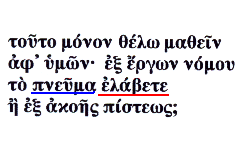 |
I would like to learn just one thing from you: Did you receive the Spirit by observing the law, or by believing what you heard? |
Greek Word |
Meaning |
|
Appears 7 times in the New Testament and is usually translated as take except in John 20:22 where it is translated as receive The root word means take or receive but the stem of the root word has been augmented to give it the following meanings verb aorist active imperative 2nd person pleural This is a strong request or command directly to more than one subject and the command was completed but the action in the command has not necessarily taken place at the time the command was given eg He said "take and eat, this is my body" (Matt 26:26 ALSO Mark 14:22 Luke 22;17) eg Take the prophets for example (James 5:10) eg Take him yourselves and judge him (John 18:31) eg Take him and crucify him (John 19:6) eg He commanded them to "take the Holy Spirit" (Jn 20:22) Being in the imperative tense, it cannot indicate time. (see Mounce's Analytical lexicon) eg Go to see your mother and take a box of chocolates This word could be translated a 'receive' in John 20:22 but the context and the absence of any other scriptures to confirm such a significant event suggest that this word should be translated as 'take' in John 20:22 (otherwise it would unique in that it would be the only scripture in the Bible to say that the disciples received the Spirit before Pentecost)
|
|
Appears 11 times in the New Testament and is translated as received. The root word means take or receive but the stem of the root word has been augmented to give it the following meanings verb aorist active indicative 2nd person pleural Same tense as word above but indicative, not imperative. Therefore, this is not a command. It is a completed action by more than one subject. eg Did you receive (Gal 3:2)
|
|
Appears 26 times in the New Testament. Usually translated as received or took and rarely as attained, caught or held The root word means take or receive but the stem of the root word has been augmented to give it the following meanings verb aorist active indicative 3rd person pleural same as above but third person pleural eg They have received (Acts 10:47)
|
|
Appears 5 times in the New Testament. Usually translated as receive and once as accept (you will accept him - John 5:43) The root word means take or receive but the stem of the root word has been augmented to give it the following meanings verb future middle indicative 2nd person pleural eg and you will receive the gift of the Holy Spirit (Acts 2:38) eg you will receive power when the Holy Spirit (Acts 1:8)
|
|
Appears 3 times in the New Testament. Translated as receive or obtain. The root word means take or receive but the stem of the root word has been augmented to give it the following meanings verb aorist active subjunctive 3rd person pleural eg they prayed for them that they might receive the Holy Spirit (Acts 8:15)
|
|
Appears only once in the New Testament. Translated as receive. The root word means take or receive but the stem of the root word has been augmented to give it the following meanings verb imperfect active indicative 3rd person pleural eg they were receiving the Holy Spirit (Acts 8:17)
|
 |
conjunction and, also, but, even, that is, namely
|
 |
demonstrative pronoun this, this one, he, she
|
 |
If by any means, if possibly
|
 |
Appears 6 times in the New Testament. It is usually translated as And when he had said this or After he had said this
|
 |
Only appears in John 20:22. The root word is not used in the bible. It is not the same word as to breath. The root word means to blow or breath into or inflate eg playing a flute. The stem of the root word has been augmented to give the following meanings verb active aorist indicative 3rd person singular Translated as he breathed on them.
|
 |
The root word means gather and lay in order or say, speak, tell, narrate, tell of, report, recount The stem of the root word has been augmented to give the following meanings verb indicative present active 3rd person singular
|
 |
Not listed in available lexicons translated as them
|
 |
Appears 33 times in the New Testament. Usually translated as and he said, he replied or he asked them
|
 |
Spirit, inner life, self, disposition, state of mind
|
 |
Set apart to or by God, consecrated, holy, morally pure, upright As in Holy Spirit
|
Notes
active - a form of a verb showing that the subject is the agent that performs the action expressed in the verb
aorist - a set of verb forms that indicate that the action in the verb has been completed
future - a set of verb forms that indicate that at the time of discourse, the action in the verb had not yet happened
imperative -a form of a verb that indicates a command or a strong request. (It is only used in the present and the aorist tense in the new testament. In the aorist tense, the endings are added directly onto the tense formative. There will be no augment in the aorist since the imperative cannot indicate time. Ref Mounce)
imperfect - a set of verb forms that indicate that at the time of the discourse, the action in the verb was incomplete or continuing in the past
indicative - a form of a verb that indicates an act or condition as an actual fact rather than as unrealised condition, a possibility or a wish
middle voice - form of a verb showing the subject is the agent in the action in the verb and that action reflects back on the subject (eg I washed and then I ate)
pleural - indicates more than one person or thing is involved
present - a form of a verb that indicates that at the time of the disclosure, the action in the verb was continuing or being repeated.
singular - indicates only one person or thing is involved
subjunctive - a form of the verb that indicates that an act or a state is not an actual fact, but is possible, desirable, probable or wished
verb - a word that describes an action
1st person something being done by the speaker - pronoun "I did"
2nd person something being done by the listener - pronoun "you said"
3rd person something being done by a third party - pronoun "he/she/it loves"
Numbering Systems
Words that come from the same root word have the same Strong's Number. Strong's numbers were designed so that people who could not read Greek could study the language. The Goodrick-Kohlenberger numbering system is another numbering system designed to make it easy for non Greeks to study the language. It also give a number for each family of words that relate to the root word from which they are derived. The problem with these numbering systems is that they do not permit analysis of individual words within a family. This is especially true to the words derived from lambano which have the Strong's number of 2983 (Goodrick-Kohlenberger number 3284).
It would be good if every word had it's own number (eg 3284a 3284b...3284z) or even better if people learn to look up Greek words in lexicons.
In John 20:22 - Did Jesus say
"Take the Holy Spirit"?
or
"Receive the Holy Spirit"?
And when he had said this, he breathed out, and said to them, (Take / Receive) the Holy Spirit
The word for take / receive is

This word appears 7 times in the New testament
Matt 26:26 While they were eating, Jesus took bread, gave thanks and broke it, and gave it to his disciples, saying, "Take and eat; this is my body."
Mark 14:22 While they were eating, Jesus took bread, gave thanks and broke it, and gave it to his disciples, saying, "Take it; this is my body."
Luke 22:17 After taking the cup, he gave thanks and said, "Take this and divide it among you.
John 18:31 Pilate said, "Take him yourselves and judge him by your own law." "But we have no right to execute anyone," the Jews objected.
John 19:6 As soon as the chief priests and their officials saw him, they shouted, "Crucify! Crucify!" But Pilate answered, "You take him and crucify him. As for me, I find no basis for a charge against him."
John 20:22 And with that he breathed on them and said, "Receive the Holy Spirit.
James 5:10 Brothers, as an example of patience in the face of suffering, take the prophets who spoke in the name of the Lord.
It is translated as 'take' every time, except John 20:22
Should this word be translated as 'take' in John 20:22?
What Tense is this word?
verb - a word that describes an action "take" "carry" "accept" "receive" "bring"
2nd person something being done by the listener - pronoun "you take" or "take with you - you carry" "you accept" "you receive"
pleural - indicates more than one person or thing is involved (you pleural)
active - a form of a verb showing that the subject is the agent that performs the action expressed in the verb (the disciples were being commanded to take/receive). This is the opposite of passive which would imply something was being done to the disciples and not by the disciples.
aorist - a set of verb forms that indicate that the action in the verb has been completed (unless combined with the imperative.) Here it indicates that the command has taken place.
imperative -a form of a verb that indicates a command or a strong request. (It is only used in the present and the aorist tense in the new testament. The imperative cannot indicate time. Ref Mounce) eg go and see your mother and take a box of chocolates - {it may be quite some time before mother gets her chocolates}
If I say to somebody "when you go to see your mother take some flowers", it does not mean that they have taken the flowers to their mother at the time I said "take the flowers". Obviously, I mean at some time in the future, "take some flowers". If I said "Whenever you go to your mother, you should take some flowers" I may be referring to the past present or future.
Jesus said "As the father has sent me, I am sending you.........take the Holy Spirit .......if you forgive anybody their sins, they are forgiven." Jesus was saying "I AM SENDING YOU TO (JERUSALEM, SAMARIA AND TO THE ENDS OF THE EARTH) TAKE THE HOLY SPIRIT (WHICH I AM ABOUT TO GIVE YOU) (WITH YOU OR TO THEM) AND WHOEVER YOU FORGIVE WILL BE FORGIVEN."
This word can be translated as take and is usually translated as take when used in this tense.
Take fits better with the context of the verse.
There are no other verses in the Bible that say that the disciples received the Spirit before Pentecost.
In fact, if the disciples received the Spirit on the Sunday that Jesus rose from the dead, then this would be at odds with other scriptures.
How does this agree with other scriptures?
John 7:39
By this he meant the Spirit, whom those who believed in him were later to receive. Up to that time the Spirit had not been given, since Jesus had not yet been glorified.
John 16:7
But I tell you the truth: It is for your good that I am going away. Unless I go away, the Counselor will not come to you; but if I go, I will send him to you.
Luke 24:49-51
I am going to send you what my Father has promised; but stay in the city until you have been clothed with power from on high." When he had led them out to the vicinity of Bethany, he lifted up his hands and blessed them. While he was blessing them, he left them and was taken up into heaven.
Acts 1:4-5&9
On one occasion, while he was eating with them, he gave them this command: "Do not leave Jerusalem, but wait for the gift my Father promised, which you have heard me speak about. For John baptized with water, but in a few days you will be baptized with the Holy Spirit."
After he said this, he was taken up before their very eyes, and a cloud hid him from their sight.
Receiving the Spirit is the Same as Baptism in the Spirit and the Holy Spirit being poured out
It is the first coming upon or filling with the Spirit
See Receiving the Spirit -- A Study of the Greek Language
See Message on Taking or Receiving
See message on John 20:22
Conclusions
There is only one type of Receiving the Spirit
The disciples did not receive the Spirit when Jesus appeared to them in the upper room on resurrection Sunday.
The disciples received the Spirit at Pentecost, 50 days later.
Jesus had to go before the Holy Spirit could come.
The word 'take' does not imply that the disciples received the Holy Spirit that day
Rather, the word 'take' indicates that the disciples were being commanded to 'take' or 'carry' the Holy Spirit with them at some future time when the Holy Spirit had been given to them
John 20:21-23 becomes a statement of the great commission which would be quite fitting as all of the Gospels would then end with a statement of the Great Commission